“Are [problems] born wicked or do they have wickedness thrust upon them?”
There is no solution to climate change. Or, let me rephrase that: There is no one solution to climate change. The issue of climate change, as well as most (if not all) of the associated challenges represent wicked problems. While we don’t really have a plan on how to solve those types of problems, the Design Thinking approach may be the best option we have at this time to make progress happen despite people’s different priorities and disagreements about the best approach.[1]
What makes a problem so wicked?
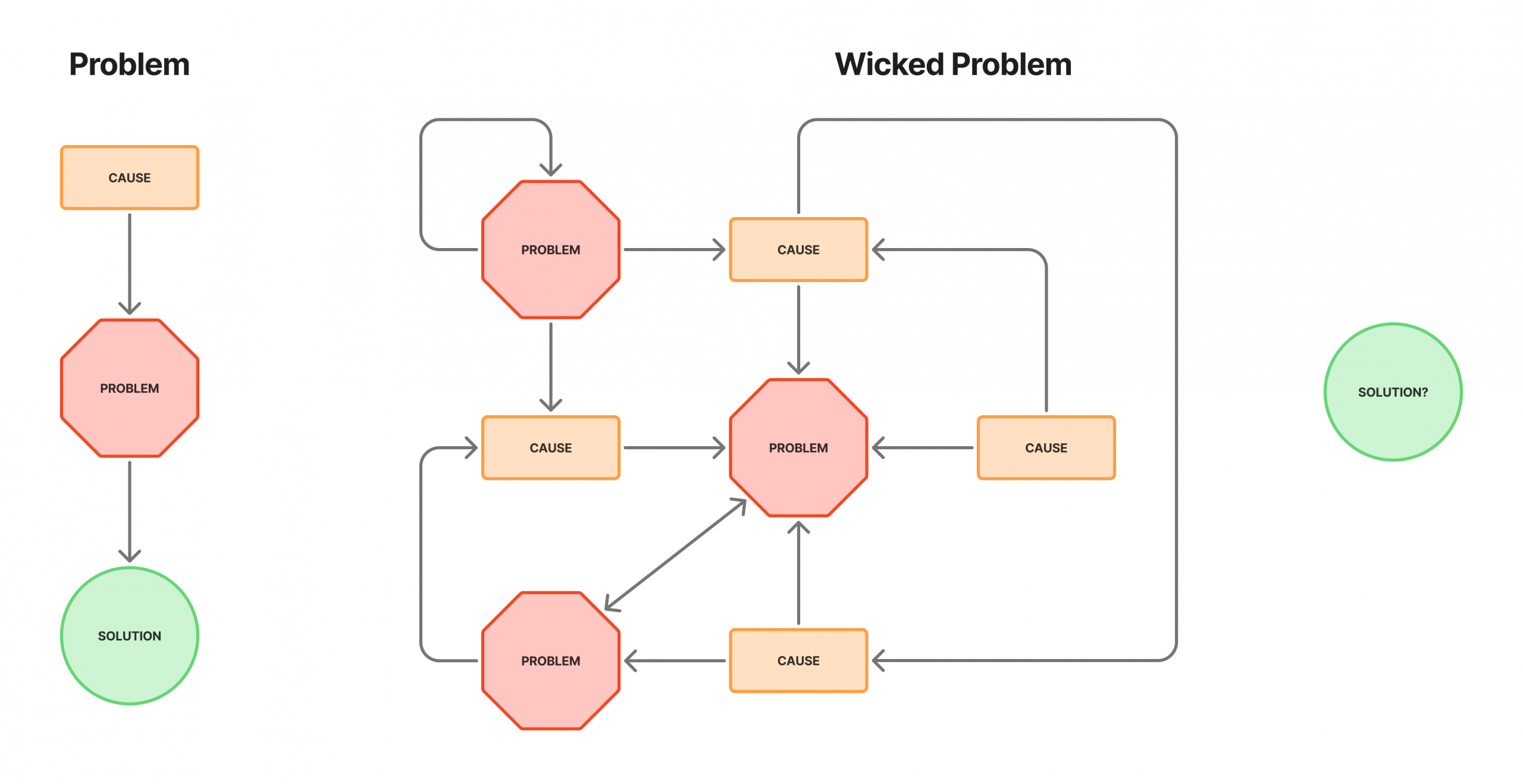
While definitions of the word ‘wicked’ range from morally very bad and evil all the way to excellent, wicked problems present problems that are very difficult to fully define and have no stopping rule, meaning no point at which they would be considered ‘solved’.[2] As we cannot solve them, we instead try to ‘deal with’ them as a way to address these often urgent issues – even if some prefer to deny, deflect and delay the matter. In this post, I briefly talk about the ten characteristics of wicked problems.
Dealing with Design Thinking
If a problem does not have a defined point where it is ‘solved’, it is clear that we need a ‘solution’ that is never finished either. Design Thinking is famously a reiterative process that could – at least in theory – be repeated infinitely. It provides a very necessary alternative to linear ways of knowledge generation, and particularly of taking action with said information. This applies in particular to the relationship between science and policy-making, where knowledge and action are often separated.[3] Iteration becomes impossible in such a structure, which is why scientists and policy-makers need to be able to work together throughout the entire process. The biggest issue then is to decide on a (good) goal. Different parties may have opposing views of where the focus should lie when attempting to solve a problem, or may even disagree on what the problem is.[1]
And while, especially in the field of sustainability, we would all probably like to sit and wait until there is a (often wondrous technological) solution to all our problems (don’t hold your breath), in most cases, it is better to go with whatever solution we have at the moment. Had we done that in the last decades, perhaps we would be in a much better position than we are right now. Getting everyone on the same page may yet be the most wicked part of the climate crisis.
References
[1] van Uffelen, N., Vermaas, P. & Pesch, U. Dealing with wicked problems: Normative paradigms for Design thinking. She Ji: The Journal of Design, Economics, and Innovation 10, 441–455 (2024). https://doi.org/10.1016/j.sheji.2024.11.003
[2] Rittel, H. W. & Webber, M. M. Dilemmas in a general theory of planning. Policy Sciences 4, 155–169 (1973). https://www.jstor.org/stable/4531523
[3] Maas, T.Y., Pauwelussen, A. & Turnhout, E. Co-producing the science–policy interface: towards common but differentiated responsibilities. Humanities and Social Sciences Communications 9, 93 (2022). https://www.nature.com/articles/s41599-022-01108-5
eq66ra