New here? Check out the ‘About‘ page to learn more!
On the need for transdisciplinarity
We live in a world of buzzwords, something I consider a side-effect of the emergence of written media. (Yes, I am not merely blaming social media and its various types of tags and keywords; already, newspapers had to grab passersby’s attention within a few large-lettered words). One of such buzzwords, and specifically one that is very relevant in the field of environmental sciences, is ‘transdisciplinarity’.
What is transdisciplinarity?
Transdisciplinarity, simply put, describes going beyond a discipline to also include sources and perspectives from outside of academia (whereas multidisciplinarity describes working from different academic perspectives in parallel, and interdisciplinarity takes the next step by integrating these different perspectives).[1] This may include various stakeholders, ranging from governments and businesses to NGOs and (groups of) citizens. Klein & Philipp specifically highlight the aspect of movement, where active steps need to be taken to reach out and connect, and thereby enable society-oriented research.[1]
Transdisciplinarity in environmental sciences
Let’s look at, say, climate change. In the academic world, work focuses on translating climate data into prognoses about the changes we can expect in the future, exploring ways to mitigate and adapt to the effects of climate change, which approach forward may be the most effective or efficient, etc. At the same time, society is still debating (although to a much lesser extent than just a few decades ago) whether or not climate change exists, as to how far it is our fault, and whether or not we should invest some or a lot of our money to do something about it.
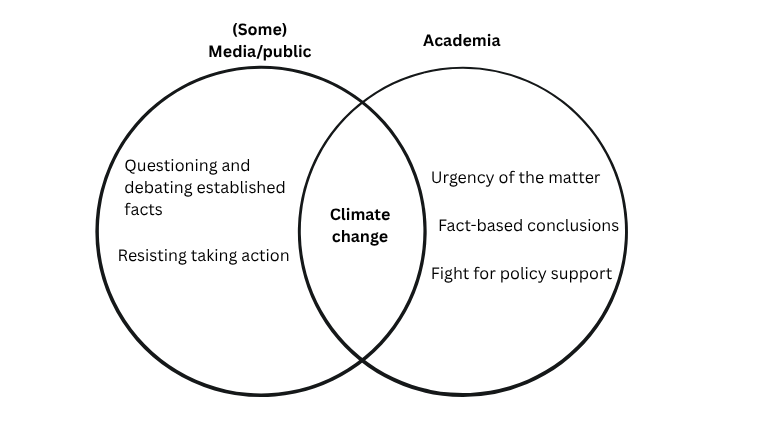
Notice the mismatch? It is difficult to jump into decisive action as recommended by innumerable scientists if society ‘as a whole’ is not on board. And even when people are on board, how can we convince them to act when it creates additional work for them? Because coming up with possible approaches and solutions is only one part- it is paramount that these solutions are workable. Lawrence et al. talk about this in terms of “social engagement”, which requires thorough collaboration and cocreation with relevant societal actors.[3] This, in my opinion, is an often overlooked aspect and perhaps the strongest case for transdisciplinarity in environmental sciences.
References
[1] Vilsmaier, U., Merçon, J. & Meyer, E. in Handbook Transdisciplinary Learning 6, 381–391 (transcript, 2023). https://library.oapen.org/bitstream/handle/20.500.12657/76285/9783839463475.pdf?sequence=1)
[2] Sclavi, M. The role of play and humor in Creative Conflict Management. Negotiation Journal 24, 157–180 (2008). https://doi.org/10.1111/j.1571-9979.2008.00175.x
[3] Lawrence, M. G., Williams, S., Nanz, P. & Renn, O. Characteristics, potentials, and challenges of Transdisciplinary Research. One Earth 5, 44–61 (2022). https://doi.org/10.1016/j.oneear.2021.12.010
ulvysi